Two cable, two purposes. What do they look like, what do they do and what are they for?
Well, visually they are very easy to tell apart, while both have a latching mechanism to keep them from falling out.
RJ11
- The smaller of the two connectors
- Has four connectors in the form of two twisted pairs of wire
RJ 45
- The larger of the two connectors
- Has eight connectors in the form of four twisted pairs of wire
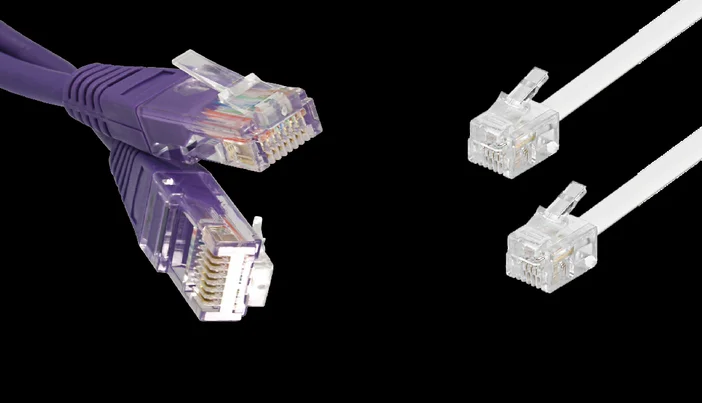
What do they do?
RJ11
- For analogue data transmission
- For use with Telephones, fax machines and some scanners
- Cannot transmit digital data
RJ45
- For Digital data transmission
- For computers, Routers and network devices
- Cannot transmit analogue signals
RJ11
RJ11 is not as common as it once was as RJ45 allows more flexibility as we will explain later. Initially used for telephones, then fax machines, and early internet modems.
The sound of early dial up modems is likely engrained into some of our memories, but that sound we heard was the data, not the song of its people. Due to the limitation of the cable the data was transmitted as sound, then converted via the modem from the analogue audio signal into a digital signal of ones and zeros. But, due to limitations in bandwidth speeds could only go up to 56 kbit/s which commonly equated to 40–50 kbit/s.
RJ45
Now the mainstay of networks coming in various standards for differing needs from Cat5 all the way to Cat8. These cables allow up to 40Gbp/s which when compared to the 40–50 kbit/s is a monumental upgrade in speed.
These cables are used modern computer networks, datacenters, home and business routers. All ethernet devices use these, chances are if there is data being moved, then one of these cables are being used.
A key reason RJ45 cables are so much faster is the data being sent, with twice the number of twisted pairs (going from four, to eight) and a wider bandwidth allowing more data to be transmitted in a given time. Also, it was designed to move digital data, while RJ11 was designed for telephones then adapted to handle low speed digital data.
JOIN OUR OFFICIAL CORSAIR COMMUNITIES
Join our official CORSAIR Communities! Whether you're new or old to PC Building, have questions about our products, or want to chat about the latest PC, tech, and gaming trends, our community is the place for you.