BLOG
Dual Chamber vs Triple Chamber Case: What's The Difference?
If you've ever gone from a standard case to a dual chamber case, you probably noticed that the additional chamber in your dual chamber case made cable management a lot easier and made the whole PC look tidier. This is a good benefit, but performance-wise, dual chamber cases don't offer much. A triple chamber case like the CORSAIR AIR 5400 though? That does make a difference.
This page is going to explain what a dual chamber case is, what a triple chamber case is, and why the triple chamber type
What is a Dual Chamber Case?
Simply put a dual chamber case has two chambers which are typically divided as follows:
- Chamber 1: All of your main components such as motherboard, GPU, CPU and the CPU cooler, be it an air cooler or an AIO.
- Chamber 2: the PSU, SSDs, HDDs, and cable clutter.
Notice that the components that generate most of the heat are still grouped together. It makes everything cleaner, but doesn't help thermals.
What is a Triple Chamber Case?
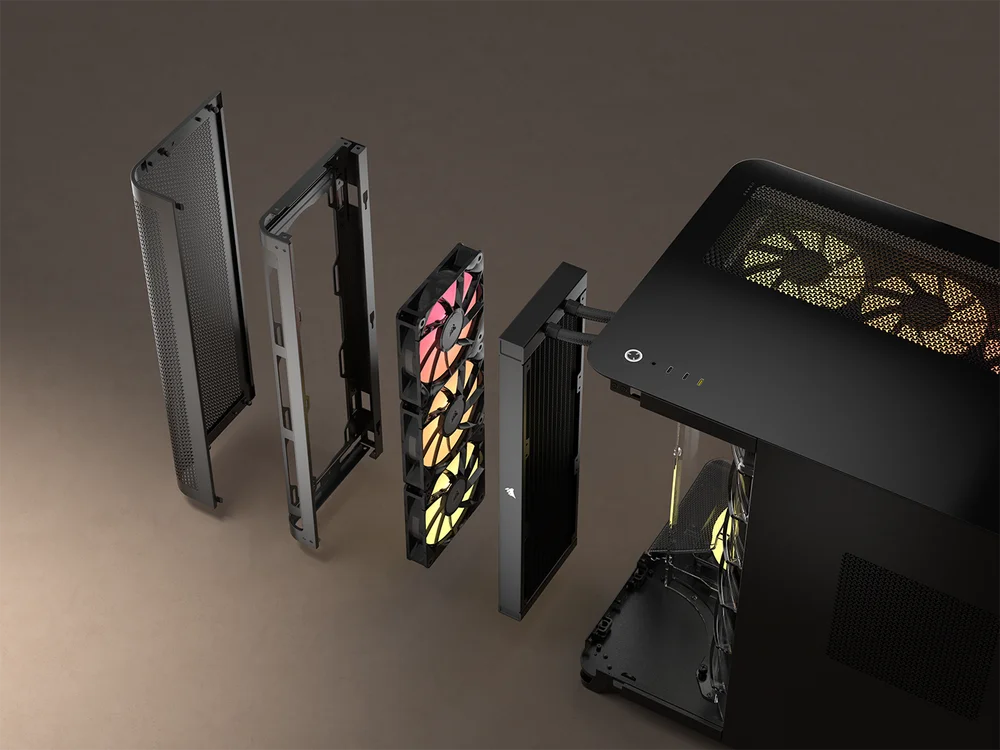
A triple chamber case on the other hand (or more specifically the AIR 5400) has three chambers, divided as follows:
- Chamber 1: Motherboard, CPU, GPU.
- Chamber 2: Power supply, HDDs, SSDs, and cable clutter.
- Chamber 3: AIO cooler for CPU.
So, even though the motherboard, GPU and CPU are still in the first chamber, the cooling for the CPU takes place in it's own isolated chamber. This means that the heat from that CPU is kept totally separate from the GPU and the heat generated by the GPU won't affect the CPU.

So fresh air comes into the third chamber, cools the CPU by going through the AIO radiator, and is sent straight back out of the case.

The image above illustrates the concept. Had we only made the AIR 5400 as a dual chamber design, then all that warm air from your CPU would not be exhausted out the side, but would be blown right into the chamber where the GPU lives, thus feeding the GPU pre-warmed air.
You could also mount the CPU's AIO cooler in the top, but then GPU would be feeding pre-warmed air into the AIO radiator, making it work harder. Unfortunately, this is how it is for most cases on the market.
The benefits of a triple chamber case are especially relevant today as modern systems can draw up to 600W on the GPU, so the gain from isolating the GPU's heat away from the CPU's cooling solution is substantial.
ΠΡΟΪΟΝΤΑ ΣΕ ΑΡΘΡΟ
JOIN OUR OFFICIAL CORSAIR COMMUNITIES
Join our official CORSAIR Communities! Whether you're new or old to PC Building, have questions about our products, or want to chat the latest PC, tech, and gaming trends, our community is the place for you.