GLOSSARY
What is ITX?
ITX motherboards, sometimes referred to as "Mini ITX" are the smallest common form factor for motherboards.
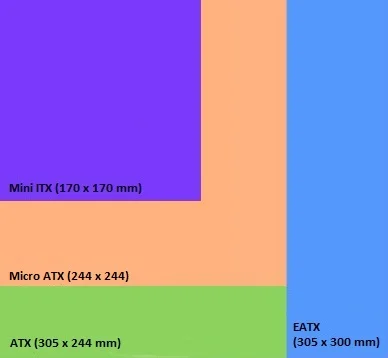
These come in at 170mm X 170mm which is even smaller than the already-diminutive Micro ATX form factor.
While not as popular as the others, it's gaining popularity as it provides the perfect base for super-compact gaming PCs, which are becoming very trendy. However, there are some notable pros and cons that come from a motherboard this small.
The Pros
- Small: This is pretty clear when looking at the image above. Being smaller opens up options for cases and placement that otherwise would not be available.
- Portability: Being small means that the entire PC case can be remarkably compact, which usually makes it lighter too. ITX PCs are an ideal choice for LAN parties for this reason.
- Flexibility: ITX motherboards have impressive capabilities that bely their size. This means they can be used in a wide range of computing applications, from high-performance gaming PCs to home NAS boxes.
The Cons
- Connectivity: As the board is smaller, there is less physical space for fan headers, SATA ports, and cooling, to name a few. This has been solved to a point with recent ITX motherboards using daughter boards, but even this results in some drawbacks as you'll need to manage a lot of cables in a cramped space.
- Maximum memory: If you wish to run four DIMMs of memory, you cannot use a Mini ITX board, as the maximum capacity is just two modules.
- Cost: ITX boards, due to their complexity and smaller market share cost more stacked up against a comparable ATX motherboard.
What features do ITX boards have?
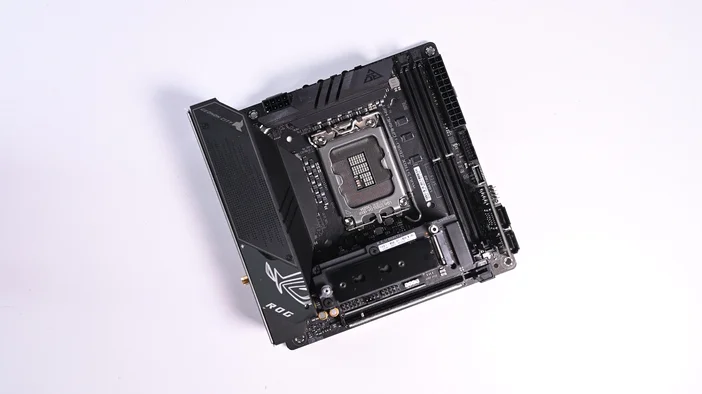
- Two RAM slots
- Two to three M.2 slots
- One PCIe 16 Slot
- Internal USB and SATA headers
- Front audio and power connectors
This differs slightly on some boards that have daughter boards, these are used due to how densely packed the boards can become.
ITX comes into its own if you have a smaller area to work in, when you compare the footprint of a 2000D to a 4000D FRAME you can immediately see the appeal.

Are Mini-ITX Motherboards compatible with normal CPUs?
Yes. But it's always worth checking the motherboard compatibility lists first as some will require a BIOS update in order to recognize the CPU.
Can I use a Mini-ITX Motherboard in a Normal Case?
Yes, an ITX motherboard will fit into most cases so long as the smaller footprint motherboard standoffs are present. You can confirm this on the case specification page which will state the motherboard sizes which it is compatible with.
What are the disadvantages of a Mini-ITX motherboard?
Because the board is physically smaller, you can miss out some of the features you would get on either an M-ATX or full size ATX motherboard.
Commonly you will not be able to use as many M.2 drives or and only two sticks of RAM as you only have the two DIMM slots.
You will also only have the single PCIe 16X slot, as there is no space on the motherboard to have this. So if you wish to have a capture card for example, it would need to be external.
In summary, an ITX board is a small but flexible motherboard that can work in both light duty gaming or office builds as well as heavy gaming or production builds. It allows a small power dense PC but does have limitations in terms of maximum storage and additional add in cards.