The CORSAIR iCUE LINK 5000T LX Mid-Tower case ships with a dazzling array of RGB lighting right out of the box. For builders who want their system to stand out from the crowd, this case delivers a visual spectacle that’s hard to ignore.
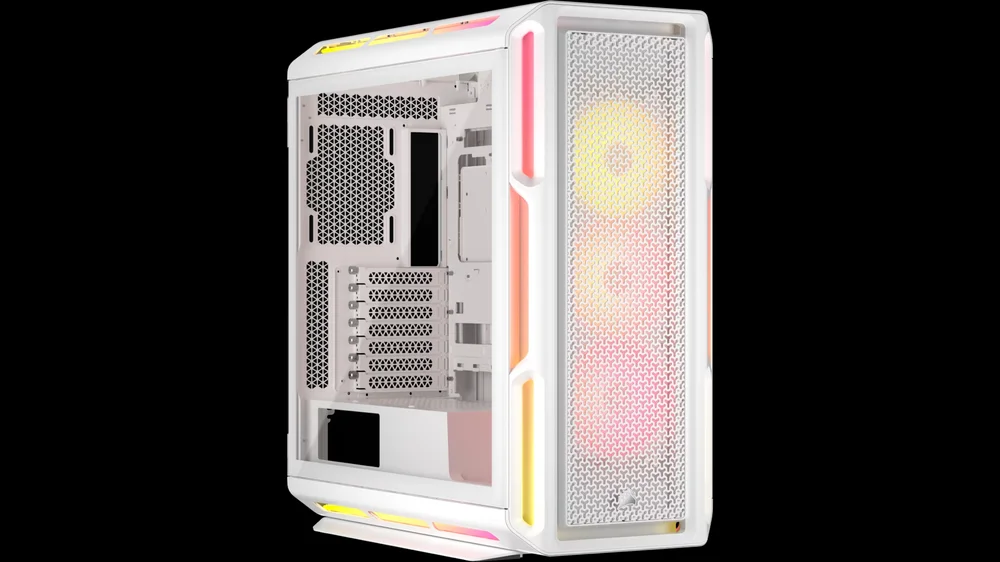
You get three iCUE LINK LX120 RGB fans pre-installed. These don’t just offer great airflow but pack some seriously vibrant lighting as well. Complementing them are six bespoke Aurora RGB light strips that provide smooth, diffused illumination. These are placed around the case to really make it pop: two vertical strips on either side of the front panel, and four horizontal strips at the top and bottom along the left and right interior edges.
That’s a lot of RGB. But let’s put some numbers on things.
RGB LED Count
| Top | Bottom | Front | |
| Left | 32 | 32 | 38 |
| Right | 32 | 32 | 38 |
That’s 204 RGB LEDs from the Aurora strips alone. Add in the 18 LEDs per LX120 fan (three fans = 54 LEDs), and you’re looking at a total of 258 addressable RGB LEDs. And that’s before you even consider adding more fans or an CPU cooler such as the iCUE LINK TITAN 360 RX RGB AIO Liquid CPU Cooler.
Intelligent Power Management
With great lighting comes great power demand. The iCUE LINK controller is smart enough to manage this – we have an article explaining how here. It dynamically adjusts brightness based on the number of connected devices and the total LED load. This ensures consistent performance and long-term reliability.
When the system approaches its power ceiling, the controller reduces brightness in 10% increments. This is a necessary safeguard to prevent issues like discoloration from power degradation and helps maintain thermal stability across the system.
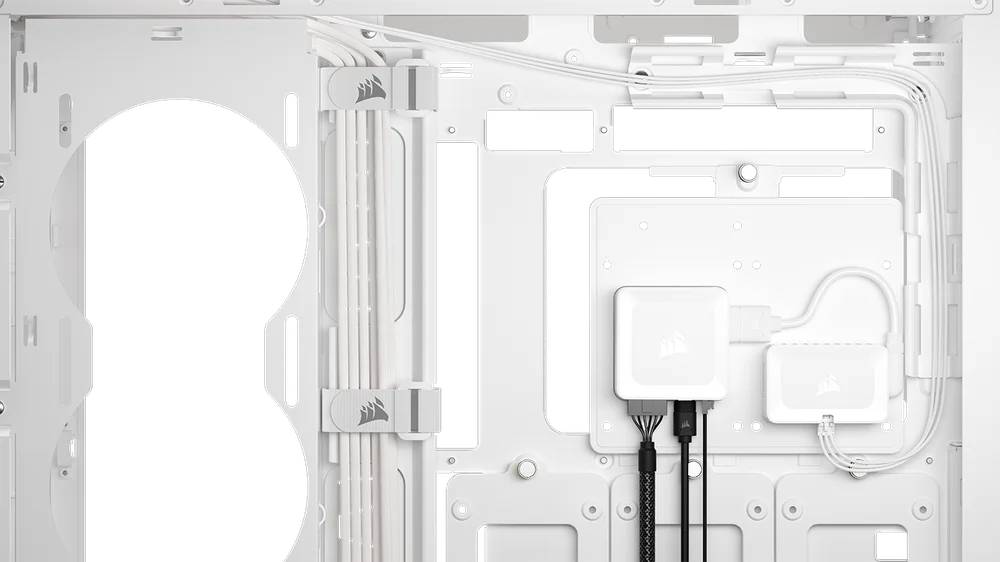
The controller applies brightness adjustments uniformly across both of its channels, even if only one exceeds the soft limit of seven devices or 238 LEDs. This ensures a consistent lighting appearance throughout your build. If you want to maintain maximum brightness, simply stay within the soft limit per channel, or use a second iCUE LINK System Hub.
This dynamic brightness scaling was a conscious design decision. We could have set a lower brightness level as the default and called it the standard for all configurations, but instead we wanted to give users more flexibility by allowing the system to scale brightness based on the number of connected devices. This approach gives builders the freedom to prioritize either brightness or simplicity depending on their setup, all without compromising reliability.
PRODUCTS IN ARTICLE
JOIN OUR OFFICIAL CORSAIR COMMUNITIES
Join our official CORSAIR Communities! Whether you're new or old to PC Building, have questions about our products, or want to chat about the latest PC, tech, and gaming trends, our community is the place for you.