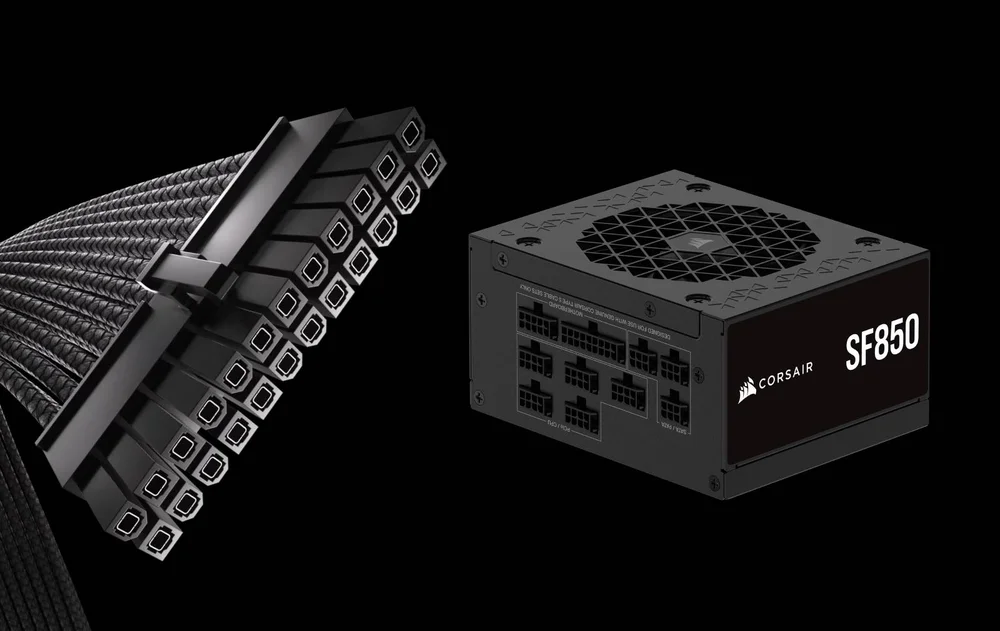
SFX PSUs are a more compact, space-efficient alternative compared to ATX PSUs. They are smaller in all three dimensions yet can now deliver up to 1000W of power. However, if you’re considering using an SFX power supply in a normal case, be aware of a few potential downsides to this approach.
(Image not to scale)
Cable Length
The first and most notable downside is that SFX PSUs, such as the CORSAIR SF850, come with significantly shorter cables. These units, along with other SFX power supplies, are built for very compact PC cases that don’t require the long cable runs typical of standard-sized PC cases. Including extended cables would actually be a disadvantage in these scenarios because managing the excess length in small form-factor builds would be cumbersome. That's why the SF Series and similar small PSUs are optimized for tight spaces.
Cable Type
If you’re wondering whether the quality, design, or actual connections differ, the answer is no. Despite SFX PSUs being physically smaller, they use the same types of cables as larger ATX power supplies.
So, while you can technically power a full-size PC with a smaller SFX PSU, the practicalities can be troublesome. In mid-to-large PC cases, it might even be impossible to stretch the short cables far enough to connect everything. We recommend buying SFX PSUs only if you plan to build a PC in an SFF case.
If you’re using a regular ATX case, stick with a normal ATX PSU. A good case, such as one from CORSAIR, will have plenty of room for the power supply and its cables, so there’s no need to try to save space with a small PSU.
PRODUCTS IN ARTICLE
JOIN OUR OFFICIAL CORSAIR COMMUNITIES
Join our official CORSAIR Communities! Whether you're new or old to PC Building, have questions about our products, or want to chat about the latest PC, tech, and gaming trends, our community is the place for you.