CORSAIR's HS80 MAX has been one of CORSAIR's most popular wireless gaming headsets, building on the original HS80 lineup with a floating headband and Bluetooth connectivity. The HS80 v2 MAX Wireless Gaming Headset is the next step in that line, and while the two headsets share a name and a silhouette, several core components underneath are new. Most of the changes center on the driver and microphone hardware, the ear cushions, and how the headset handles wireless connectivity and battery life.
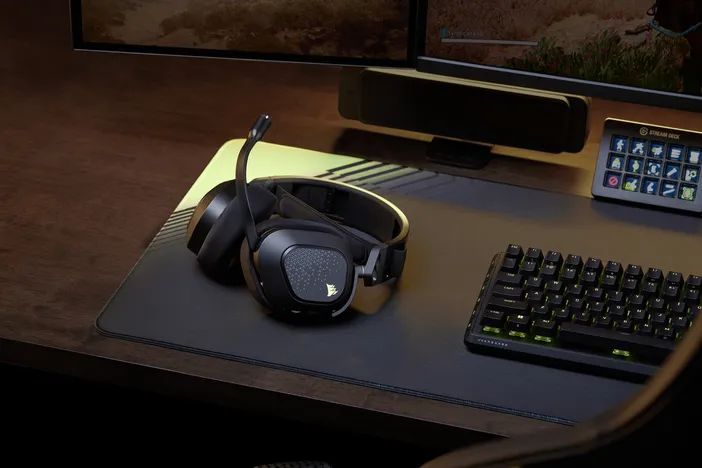
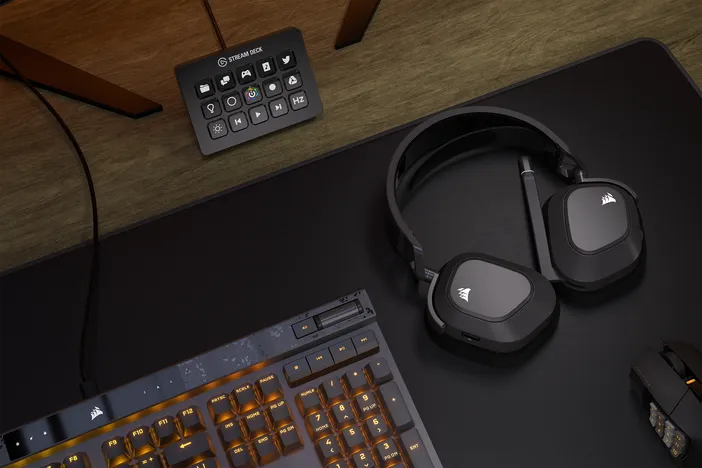
HS80 v2 Max vs HS80 Max: Tech Specs
| HS80 v2 MAX | HS80 MAX | |
| Audio Driver | 50mm neodymium with non-Newtonian laminate diaphragm | 50mm neodymium |
| Frequency Response | 20Hz-20kHz | |
| Microphone | 10mm broadcast-grade capsule with pressure-drain pop filter, omni-directional, flip-to-mute | Omni-directional, flip-to-mute |
| Connectivity | Simultaneous 2.4GHz and Bluetooth | 2.4GHz or Bluetooth |
| Wireless Range | Up to 50ft (15m) | |
| Battery Life | Up to 110 hours (2.4GHz) / Up to 130 hours (Bluetooth) | Up to 65 hours (2.4GHz) / Up to 130 hours (Bluetooth) |
| Quick Charge | 15-minute charge for 6 hours | Fast charge supported |
| Ear Cushions | Slow-rebound memory foam with cloth fabric covering | Memory foam |
| Headband | Self-adjusting floating headband, aluminum and plastic frame | |
| Compatibility | PC, Mac, PlayStation, Nintendo Switch, Mobile | PC, Mac, PlayStation, Mobile |
| Software | iCUE, NVIDIA Broadcast, Dolby Atmos | iCUE, NVIDIA Broadcast, Dolby Atmos, Sonarworks SoundID |
| RGB Lighting | Dynamic RGB | |
| Weight | 370g | 352g |
| Warranty | 2 Years | |
Non-Newtonian Laminate Drivers
The biggest change between the two headsets is what's inside the earcups. HS80 MAX uses a standard 50mm neodymium driver. HS80 v2 MAX keeps the 50mm size but rebuilds the diaphragm out of a non-Newtonian laminate (NNL) material.
The reason for the change comes down to how a standard driver behaves after a loud, sudden sound. When a diaphragm reproduces something like an explosion or gunshot, it doesn't always stop moving the instant the audio signal does. It keeps vibrating slightly on its own, an effect known as acoustic ghosting, and that residual motion can blur or mask whatever sound comes right after it. In a game, that's often the moment a footstep or a reload gets buried under the tail end of the last loud noise.
Non-Newtonian materials respond differently under sudden force than they do under a steady load, which is what lets HS80 v2 MAX's diaphragm settle back into a stable position faster than a standard laminate. The practical result is cleaner separation between a loud sound and whatever comes next, without changing how loud the headset gets overall. That faster recovery is what gives HS80 v2 MAX cleaner audio in those moments that matter.
To get a more in-depth review of NNL drivers then check out this article: HS80 v2 Max: Non-Newtonian Drivers Explained
Broadcast-Grade 10mm Microphone Capsule
Microphone hardware is another point where the two headsets diverge. HS80 MAX ships with a standard omni-directional flip-to-mute mic. HS80 v2 MAX introduces a new 10mm capsule built specifically to address plosives, the bursts of air behind hard consonants like "P," "B," and "T" that cause popping in voice chat.
Most headset mics manage plosives with a foam pop filter that physically absorbs the air pressure, but foam doesn't distinguish between a burst of air and legitimate audio content, so it can dull some high-frequency detail in the process. HS80 v2 MAX's mic uses a pressure-drain structure instead, a series of small vents that redirect high-pressure air away from the capsule rather than soaking it up. The mic is also omni-directional and flip-to-mute, matching the original, but the capsule and pop-filter design are new.
Ear Cushions
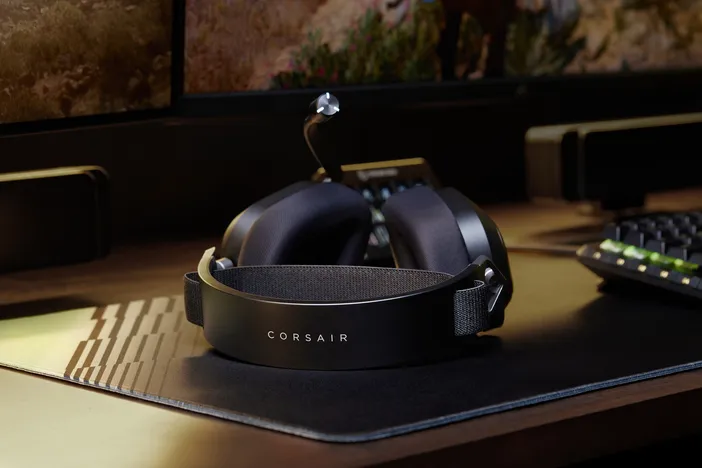

The two headsets share the same floating headband design: a self-adjusting elastic floating headband underneath a rigid aluminum and plastic frame that spreads pressure evenly across the head rather than clamping at a fixed size. HS80 v2 MAX updates the earcup padding with a cloth fabric covering over slow-rebound memory foam, aimed at holding its shape through longer sessions. HS80 MAX uses memory foam without the added fabric layer. Together, the floating headband and updated cushions are built so the earcups disappear on the head during a long session.
Simultaneous Dual Wireless, Battery Life, & Platform Compatibility
Both headsets connect over 2.4GHz wireless and Bluetooth, but they handle it differently. HS80 MAX supports both connection types, but only one at a time. HS80 v2 MAX runs both simultaneously. In practice, that means a player can stay connected to a PC over the low-latency 2.4GHz connection for game audio while a phone stays paired over Bluetooth, without switching back and forth.
Wireless range is unchanged at up to 50ft (15m) on both headsets, and Bluetooth battery life holds steady at up to 130 hours on both. The real jump is on 2.4GHz: HS80 v2 MAX now lasts up to 110 hours on a charge, up from 65 hours on HS80 MAX, enough to get through a full week gaming sessions before it needs to see a charging cable.
Both headsets work across PC, Mac, PlayStation, and mobile devices. HS80 v2 MAX adds Nintendo Switch to that list, a platform the original HS80 MAX doesn't support.
Software
Software support is where the feature sets separate the most. Both headsets work with CORSAIR iCUE for EQ customization and RGB lighting control, and both support Dolby Atmos spatial audio on PC through the Dolby Access app. However, HS80 v2 MAX no longer includes Sonarworks SoundID in iCUE.
HS80 MAX's Sonarworks SoundID is a feature that runs a short in-app hearing test through iCUE and builds a personalized EQ curve from the results. Anyone who relies on SoundID's personalized EQ profile should factor that difference in when comparing the two headsets.
Which Headset is Right for You?
HS80 MAX and HS80 v2 MAX share a lot of DNA: the same driver size, the same floating headband, and the same flip-to-mute mic design. Where they differ is at the component level. HS80 v2 MAX's non-Newtonian laminate driver and pressure-drain mic capsule are built to address specific audio problems, acoustic ghosting and plosives, that HS80 MAX's standard driver and mic don't specifically target. Simultaneous dual wireless with a longer 110-hour 2.4GHz battery life, Nintendo Switch compatibility, and updated ear cushions round out the rest of the changes, providing a great quality of life upgrade compared to its predecessor. For players deciding between the two, HS80 v2 MAX is the newer hardware platform, built around driver and microphone changes that matter most for audio precision and communication quality.
PRODUCTS IN ARTICLE
Stay up to date with CORSAIR. Get our latest News, Guides, and Product Updates in your Google feeds.
Add CORSAIR as a preferred sourceWas this article helpful?
Feedback received
Thanks for helping us improve this article.
JOIN OUR OFFICIAL CORSAIR COMMUNITIES
Join our official CORSAIR Communities! Whether you're new or old to PC Building, have questions about our products, or want to chat about the latest PC, tech, and gaming trends, our community is the place for you.