GLOSSARY
What is a GPU?
GPU stands for Graphics Processing Unit. It is the logic responsible for handling everything related to computer graphics in your PC. Its name closely resembles the CPU at the heart of your system, the Central Processing Unit, and the GPU is another essential component that is vital for gaming. Like the CPU, it relies on other components to do its job, including buses that move data, control logic, and memory required to store the models, textures, and shaders during workloads.
A GPU is not a graphics card.
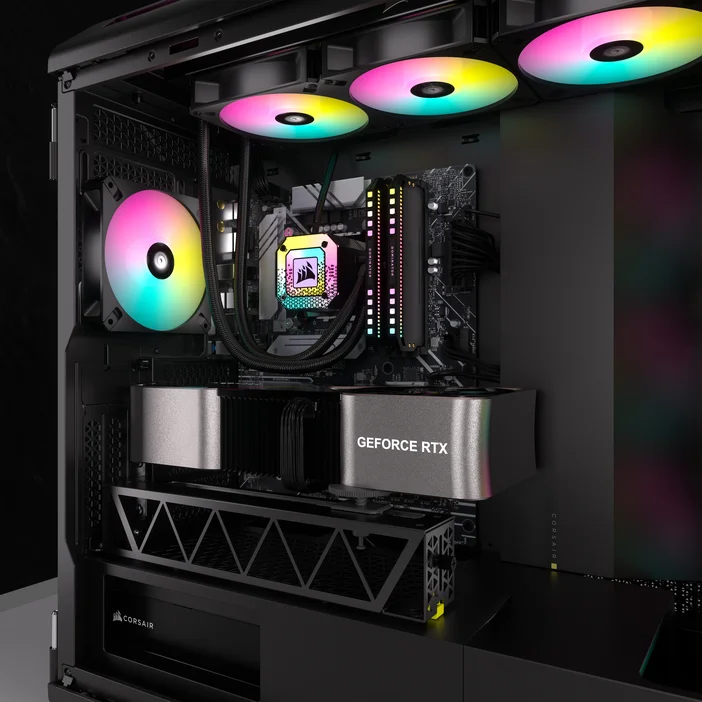
The GPU is the chip found at the heart of a graphics card, but you will also find GPUs inside modern CPUs or in laptops as part of an integrated solution. The GPU needs VRAM, or Video RAM, to do anything useful. This is a specific type of fast memory used for handling textures, models, and other graphical data. A graphics card also includes physical outputs that let you connect your PC to one or more monitors.
GPU Manufacturers
For PC gaming, there are three major GPU makers: Nvidia, AMD, and Intel. These companies create the actual GPUs that board partners such as ASUS, MSI, and Gigabyte place on their graphics cards. Those cards are then sold to us as end users. Nvidia, AMD, and Intel also produce their own reference graphics cards, although these often sell out quickly because production tends to be limited.
When companies like ASUS, MSI, and Gigabyte build a graphics card, they follow specifications and recommendations from the GPU manufacturer. Even so, cards built around the same GPU are not identical. Vendors control the type of cooling, the quality of the power delivery, and other important choices. These details allow them to fine tune GPU and VRAM frequencies to get the most from the silicon while keeping temperatures under control. As a result, each manufacturer often creates a range of cards based on the same GPU, with different performance levels, cooling approaches, and prices.
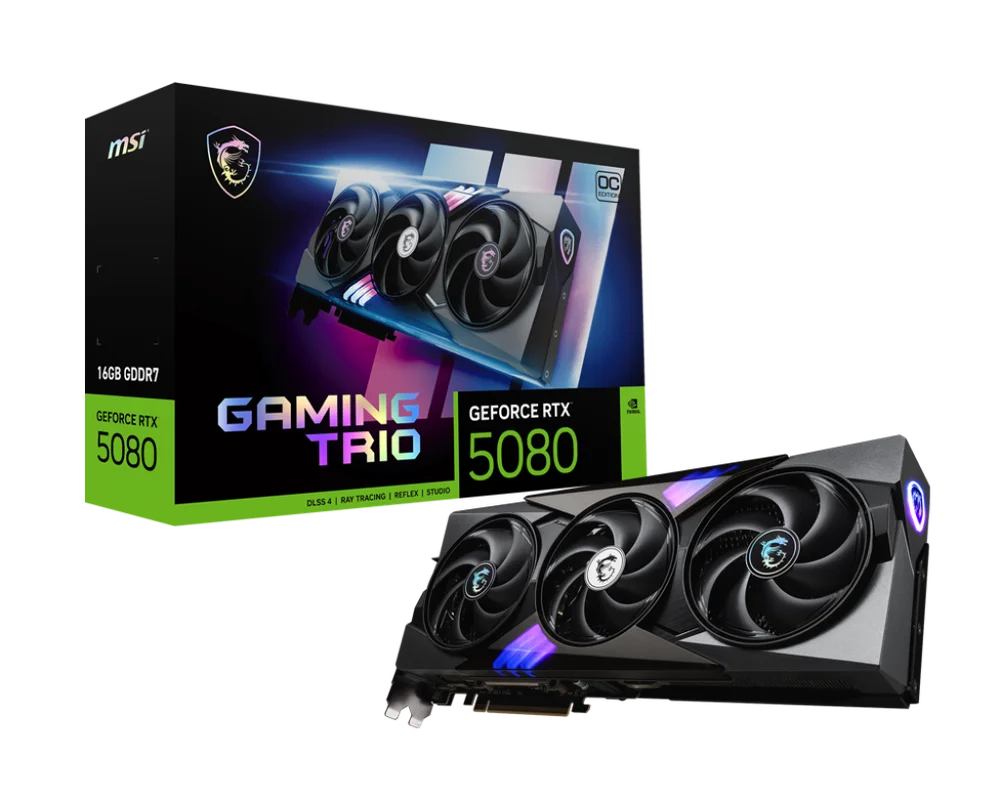
For example, MSI offers a wide lineup of graphics card families, including Shadow, Ventus 3X, Suprim, Inspire 3X, Vanguard, and Gaming Trio, among others. MSI has produced more than 30 different graphics cards built around the NVIDIA GeForce RTX 5080 GPU alone. These cards vary in clock speeds, cooler sizes, color schemes, and overall build quality. Unsurprisingly, this leads to a broad range of prices even when every model uses the same underlying GPU.
That’s just for one, admittedly very popular, GPU. When you factor in the rest of the Nvidia GeForce RTX 50 series, including the RTX 5090, 5070 Ti, 5070, 5060 Ti, 5060, and 5050, you can quickly see that there is a staggering number of graphics cards available.
GPU as a Class
Earlier, we stated that a GPU is not a graphics card. Even so, the word GPU is often used to refer to a graphics card class when referring to recommended specs and capabilities. This is because it is impractical to list every specific model when referring to performance requirements. For instance, a game may simply state that it requires an Nvidia RTX 5080 to achieve smooth frame rates at high settings for a given resolution. Listing every single model from every manufacturer would only cause confusion.
While there can be a performance gap between the slowest and fastest RTX 5080 cards, it is not large enough to make this classification unhelpful. Stating a required GPU class is the only sensible way to communicate this information.

Evolving GPUs
As GPUs have evolved, their internal structure has changed dramatically. Modern GPUs now feature thousands of small processing units that work in parallel. This gives them tremendous computing power for tasks that benefit from large numbers of simultaneous calculations. This is why GPUs have become essential for areas such as machine learning, AI workloads, and real time ray tracing. Their ability to process many operations at once makes them far more suitable for these tasks than CPUs, which focus more on fast sequential performance.
As stated earlier, modern CPUs include increasingly capable integrated GPUs. These can handle lighter gaming workloads at reasonable frame rates when using lower resolutions and reduced settings. Integrated GPUs usually rely on shared system memory instead of dedicated VRAM. This limits their performance compared to a dedicated graphics card, but the convenience and value make them attractive for laptops, compact PCs, and non-gaming systems.
In short, a GPU is a core component of any computer. Whether you’re talking about a high-end graphics card, a mainstream laptop, or a compact gaming handheld, the GPU provides the capabilities to bring gaming, applications, and creative tools to the fore.