These are two types of display technologies based on OLED, which stands for Organic Light Emitting Diode. In a display with OLED technology, every pixel is a carbon-based organic compound that emits light when current is applied to it. In these panels there is a super-thin layer of OLED film in between two conductive panels with current passing through them.
As electrical current leaves one panel on its way to the other, it passes through the organic layer between them, causing the individual pixels to become illuminated. At the same time, this means some pixels can have no current applied to them, so they are turned off completely, resulting in pure blacks and vivid contrast that is not possible with older LCD technology.
On the other hand, AMOLED is a type of OLED panel that stands for Active Matrix OLED, and it is the most common form of high-end OLED panel used today and it's extremely popular in smartphones.
When comparing these two acronyms, we can see the primary difference between these two technologies is the existence of an “active matrix.”
What is an Active Matrix?
An active matrix is a grid of Thin Film Transistors (TFT) that lie underneath the film containing the actual OLED pixels. This film mesh sits between the source of the current powering the display and the pixels themselves and is able to finely control which pixels receive power, so it’s like a fine-tuned version of OLED that lets the individual OLED elements turn on or off quicker than a so-called “passive matrix.”
What is a Passive Matrix?
A passive matrix OLED display is found on small and simple devices like watches and handheld devices and uses a row and column approach to addressing each pixel that needs to be illuminated. In this technology the individual pixels are addressed one row at a time sequentially, so one pixel at a time.
This limits their resolution and size, so passive matrix OLEDs are simple panels used in small devices, usually less than 3-5” diagonally. These displays are not in use very much today, and just because an OLED panel is not listed as being AMOLED does not mean it's passive.
Is Regular OLED also AMOLED?
It really depends, as the acronym OLED can apply to a lot of different variations of panel types, and there is a lot of uncertainty and marketing/branding surrounding this acronym these days, so it can be hard to pin down what kind of OLED panel is being discussed. In general, these two technologies are very similar as every OLED has self-emitting pixels, so every pixel creates light instead of relying on a backlight.
Most, if not all, high-end OLED panels also use a TFT backplane, which means they are also "active matrix" as well. Therefore, in a wide variety of panels on the market today there is no difference between OLED and AMOLED as they are all AMOLED, but again, it depends on the panel.
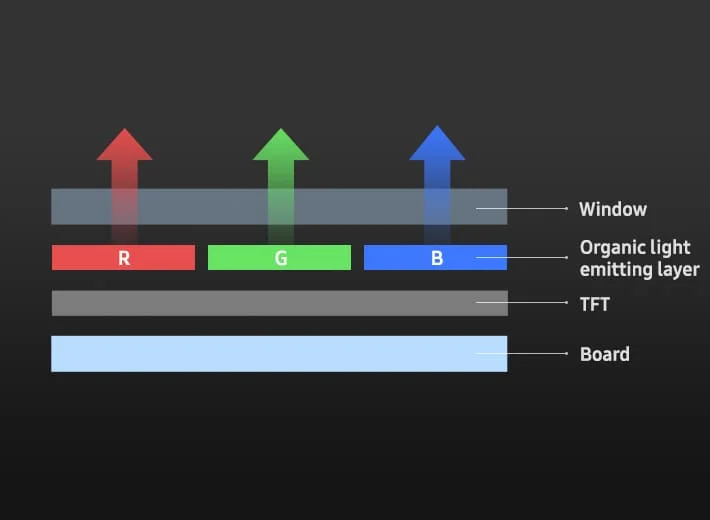
This diagram shows the structure of an OLED display with the TFT backplane controlling the power sent through the OLED layer, and then finally through the window to the viewer. Image credit: Samsung
Which is Better?
This is a tricky question as the acronym OLED can mean a lot of things these days, and some people will tell you that AMOLED is just marketing, since most OLEDs in use today have a TFT backplane with transistors to help control the current pulsing through the organic materials, making them essentially AMOLED panels. Overall, a lot of OLED panels in the market use a TFT backplane, or an “active matrix,” but are just referred to as "OLED." In a lot of scenarios, there is no difference between a TV or monitor labeled OLED and a display labeled AMOLED.
All that said, you will most likely only see a panel labeled as AMOLED in the smartphone world, as Samsung uses this labeling on the displays for some of its smartphones, and it holds trademarks for several of the variants. As a side note, nobody owns a trademark on AMOLED as it's a technical term describing a technology, not a product.
JOIN OUR OFFICIAL CORSAIR COMMUNITIES
Join our official CORSAIR Communities! Whether you're new or old to PC Building, have questions about our products, or want to chat about the latest PC, tech, and gaming trends, our community is the place for you.